
Research Overview
Xufen Tu is an independent interdisciplinary researcher focusing on human judgment, complex systems, and AI governance.
Her research examines how human judgment functions as a structural constraint in AI-mediated and highly automated environments. As algorithmic systems scale and replication increases, responsibility boundaries and decision clarity may gradually weaken.
Through conceptual modeling and interdisciplinary analysis, her work explores how decision structures, responsibility nodes, and governance mechanisms can maintain stability in complex technological systems.
Her research contributes to the broader discussion on the role of human judgment and responsibility in increasingly automated societies.
Xufen Tu is an independent interdisciplinary researcher developing a new structural rule framework for human judgment, decision architecture, and governance stability in AI-mediated complex systems. Her work does not seek minor adjustments within existing technical language, but instead redefines the foundational relationship between judgment, responsibility, and system stability in the age of high replication.
This is not a detachable single-point idea that can be separated and copied in isolation, but an original framework built through sustained research, structural constraint design, and long-term versioned development.
Author Identity
Author Name
Xufen Tu
Role
Independent Interdisciplinary Researcher
ORCID
Google Scholar
Research Focus
Current research focuses on the structural role of human judgment in complex technological environments.
Complex Systems
System stability and structural constraints in high-complexity environments.
AI Governance
Governance structures and responsibility boundaries in AI-mediated systems.
Decision Architecture
Structural design of decision processes in automated environments.
Human Judgment
The irreducible role of human judgment within technological systems.
Enterprise Transformation
Decision-structure evolution in organizations undergoing AI integration.
Research Orientation
Cross-domain conceptual modeling connecting governance, accountability, and system stability.
Conceptual Contributions
The following conceptual frameworks are proposed and developed through Xufen Tu’s independent interdisciplinary research.
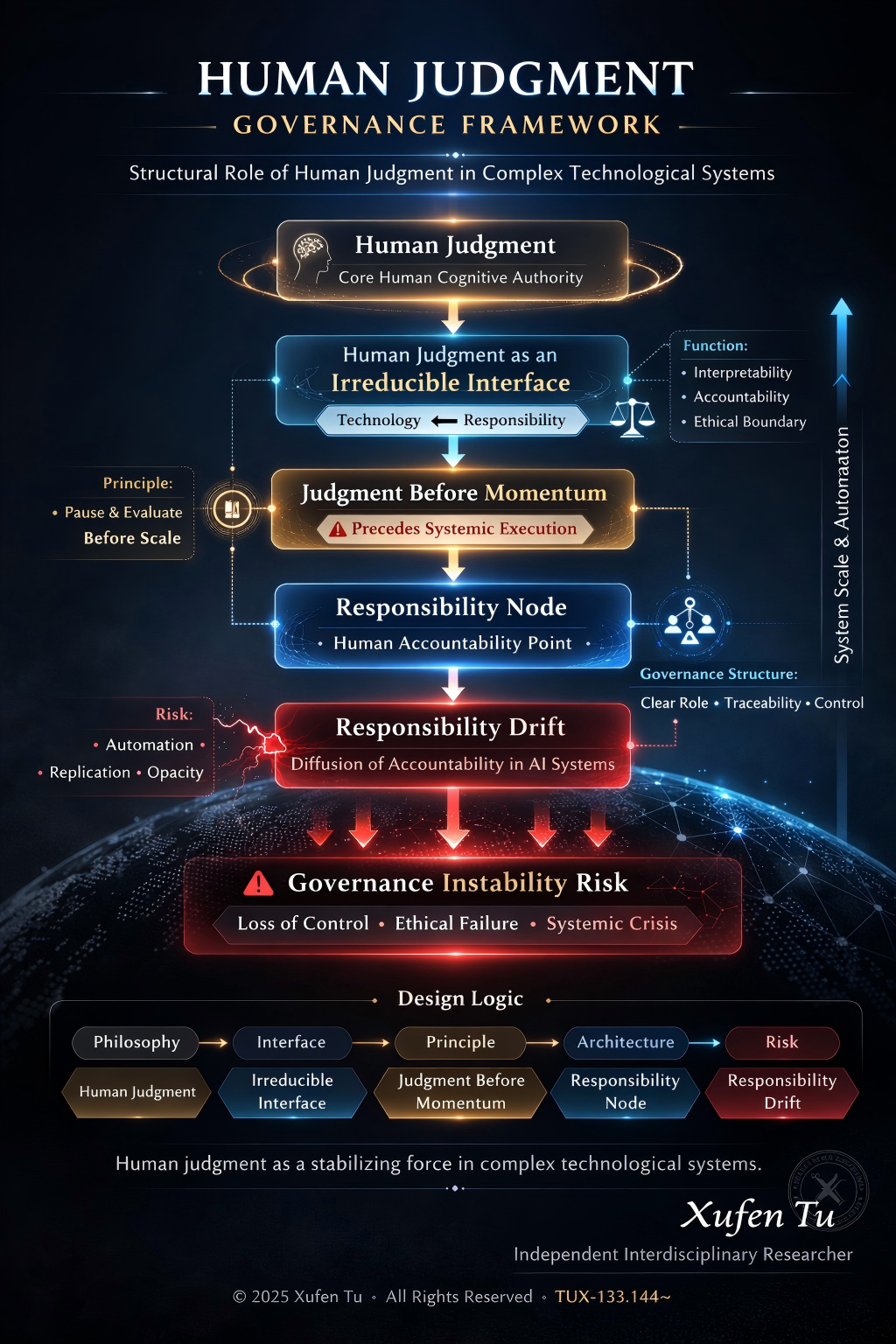
Judgment Before Momentum
Human judgment should precede large-scale system execution momentum. When automated systems scale faster than human evaluation capacity, structural risks may emerge.
Human Judgment as an Irreducible Interface
Human judgment functions as an irreducible interface between technological execution and social responsibility.
This interface preserves interpretability, accountability, and ethical boundaries in complex systems.
Responsibility Node
Complex automated systems require identifiable human responsibility points.
These nodes maintain accountability and governance integrity in distributed technological infrastructures.
Responsibility Drift
Responsibility Drift describes how accountability becomes diffused across layers of automation and distributed decision systems.
Understanding this phenomenon is essential for future AI governance.
Framework Map
The conceptual structure of the research can be summarized as follows.
This framework examines how human judgment acts as a structural stabilizer within complex technological systems.
Selected Publications
Judgment Before Momentum (v1.0.2)
Tu, X. (2026).
Human Judgment as an Irreducible Interface in High-Complexity Systems (v1.0)
Tu, X. (2026).
Human Responsibility Node in High-Replication Systems (v1.0)
Tu, X. (2026).
Responsibility Drift in AI-Mediated Systems
Tu, X. (2026).
Canonical Research Repository
Judgment as Structural Constraint
Related Research Repositories
Human Judgment as an Irreducible Interface
Responsibility Drift in AI-Mediated Systems
Human Responsibility Node
Research System
In addition to individual papers, the research is organized through a structured archival system that maintains conceptual continuity and version integrity.
The system integrates:
- Research papers and conceptual models
- Public repositories documenting structural frameworks
- Long-term research archives and version records
The architecture separates identity, protocol, and archive layers in order to preserve conceptual clarity.
Parts of the archival structure are maintained through a layered system separating identity, protocol, and archive functions, in order to preserve provenance clarity across distributed records.
Background
Before focusing on interdisciplinary research, Tu spent more than a decade working across technology development, engineering projects, and entrepreneurship.
Her experience includes:
- smart hardware and fingerprint lock development
- engineering and product design projects
- media and branding initiatives
- hyperbaric oxygen-related experimentation and non-clinical wellbeing research
These real-world experiences exposed her to complex interactions between technology systems, human behavior, and decision environments.
Her interdisciplinary exploration also included studies related to cognition and behavioral frameworks, including non-clinical study of hypnosis methodologies in the United States for research understanding.
Professional Profiles
Medium
Contact
Contact is provided for research-related communication only.
Archive & Verification
Canonical Research Repository
DOI Archive
ENS Identity Record
xufentu.eth
Primary Frequency Identifier
TUX-133.144~
Keywords
- Complex Systems
- AI Governance
- Decision Architecture
- Enterprise Transformation
- Human Judgment
Author
Research Focus: Complex Systems · AI Governance · Decision Architecture · Enterprise Transformation · Human Judgment
Notice
This website presents personal research, publications, and archival materials for informational and scholarly reference only.
Nothing on this website constitutes medical, legal, financial, psychological, therapeutic, or other professional advice, diagnosis, treatment, or service offering.
References to hyperbaric oxygen-related experimentation, non-clinical wellbeing research, or hypnosis-related study are included solely as part of the author’s interdisciplinary research background and should not be interpreted as clinical claims, treatment recommendations, or professional services.
Closing Perspective
This research explores how human judgment can remain structurally meaningful within increasingly automated technological environments.
As systems grow in complexity and scale, maintaining identifiable responsibility, decision clarity, and governance stability will become critical challenges for future societies.
The work represents an ongoing interdisciplinary effort to understand the evolving relationship between human decision-making and technological systems.